
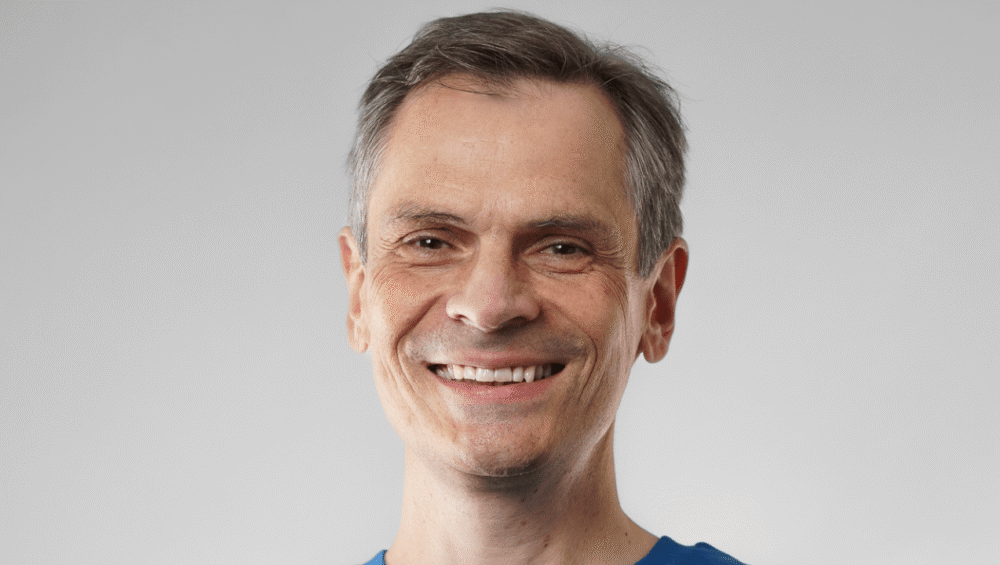
Michael Breither is COO of glueckkanja AG, which is considered one of the leading cloud managed service providers and is distinguished by its partnership with Microsoft. Michael recently joined our community and is setting up the company's first Swiss location here in the coworking space.
Michael, how did you come to glueckkanja?
After two career moves, I ended up at glueckkanja in the mid-1990s. I belong to a generation that grew up with the first PCs. We assembled them ourselves and wanted to find out what was possible with them. This is exactly what the founding story of glueckkanja is about: we all come from a computer science background and enjoyed trying out new things, seeing what could be programmed and how technology could be used to support companies.
What is your role at glueckkanja?
We became a Microsoft partner early on, which enabled us to work with larger companies. For the first ten years, I implemented Microsoft technologies as an IT consultant. As we grew, I took on responsibility for our consultants—from resource planning, recruiting, and onboarding to further developing our partnership with Microsoft. We then expanded regionally, and I increasingly took care of sales. Later, I established the "People & Culture" department at our company. I realized that we were often at a disadvantage as an employer brand compared to large competitors. That's why we are continuously working to position ourselves as an attractive employer.
In this context, does it make sense for you to take responsibility for opening new locations?
Yes, I bring together collaboration with partners, recruiting new employees, and sales. Not to mention organizational matters and implementing our culture—these are the components needed to establish new locations. When it comes to new projects, we always invite team members to contribute their ideas and input.
And what is it that you enjoy about opening new locations?
Initially, I was always driven to advance our company and organization. Two years ago, we realized that our mindset and services were not only unique in Germany. So, as a management team, we decided to tap into new markets and geographies. I am excited by these new challenges. I enjoy getting to know new cultures and new people. I enjoy finding out what it takes to build a strong team locally, make our name known, understand the market, and win our first customers.
Why open a location at all when everything could be remote?
Even though we work remotely, we want our employees to identify with glueckkanja and feel part of the corporate culture. We may only see each other a few times a year, but it is important to us that our team feels that they are not working for some anonymous company, but that they belong to us.
Is identification a particularly important value for growth?
For us, the so-called "cultural fit" is crucial. New employees should fit well into the team structure. We call this the "ski lodge test": Imagine you are spending a weekend with this person in a snow-covered ski lodge – are you looking forward to it or do you have reservations? It is important that we bring genuine team players on board. At the same time, we are looking for people who are enthusiastic about technology, tech nerds who enjoy achieving things with technology.
Why did you decide to expand internationally?
In recent years, managed services—which involve not only bringing customers into the cloud, but also providing them with long-term support—have demonstrated that this model works not only in Germany, but also in other countries. We have already worked with customers in Switzerland and Austria in the past. Microsoft has encouraged us to expand internationally, as there are not enough partners working at this level in these countries. A year and a half ago, we therefore decided to actively pursue this path.
How did you choose the locations?
Austria was a logical first step because we already had contacts there, particularly at Microsoft headquarters in Vienna. Spain was a happy coincidence because we knew someone who was experienced in that market. Our strategy is to gain a foothold in these markets, build teams, and understand the local business. Switzerland makes sense as another German-speaking country.
Spain is not a German-speaking country. Will this expansion influence your strategy and corporate culture?
Yes, definitely. In Spain, we currently have three employees, two Germans and one Spaniard – all of whom speak German and Spanish. This has helped us to overcome linguistic and cultural barriers so far. But for the future, one thing is clear: we cannot assume that all employees will speak German. That's why we will have to switch to English as our internal communication language in the long term, including in other international markets.
Is that one of the biggest challenges for you in terms of your international growth?
As a German company, we start with the assumption that our solutions and working methods are also valuable and welcome in other countries. This requires us to understand and adapt to the local culture, including linguistic challenges. Until now, this has been relatively easy, as German is the predominant language internally. Written documents are mostly in English, as we work extensively with international partners. Nevertheless, meetings such as town halls or team meetings are predominantly held in German. We realize that this is no longer sufficient when expanding into Spain. There, it will be necessary to switch to English more frequently in order to attract local professionals. This is a learning process for us, because not everyone feels comfortable with the English language right away and has the confidence to contribute to the company to the same extent – which is extremely important to us.
Why was it different with your location in Australia?
Our team in Australia operates in a different business area. It is a small team that exclusively handles the software product business worldwide. This model differs from our focus in Europe, where we offer managed services and project support. The employees in Sydney only speak English, but we are trying to integrate them into our culture.
What are the most important steps when opening a new location?
From a business perspective, it is important to understand the market and the local ecosystem. Microsoft works closely with local partners, so we need to analyze which partners are already established, where their strengths lie, and where there are gaps. This analysis helps us identify potential and take a strategic approach to entering the market. And then, of course, putting together a regional team is of utmost importance.
What is the biggest challenge in this regard?
The biggest challenge is putting together a team that embodies and can multiply our spirit and mindset. The team must not only be technically strong, but also culturally compatible with us and internalize our way of working.
Our strength lies in the fact that we are convinced of our solutions – we have a clear opinion on what the corporate IT infrastructure of the future should look like and how it should be operated. This mindset, these high quality standards, and the conviction that our solutions offer customers real added value set us apart from others.
It is crucial that new teams share this conviction. Our philosophy enables us to build long-standing, close customer relationships in which customers perceive us as the "Champions League." For example, a customer from Switzerland recently praised us for proactively warning of pitfalls and setting high quality standards—something he often found lacking in other partners.
Is it important for you to be present on site in person?
Physical presence is crucial to ensuring that our values and corporate culture are lived out locally. We don't want to simply put teams together "remotely" and have them work in shared workspaces without any personal connection. It takes time to build local teams that embody our spirit, understand market requirements, and can work successfully in the long term.
To what extent does sustainability play a role in your choice of location?
Sustainability is becoming increasingly important to us, even though it has been a topic of interest for many years. As part of the Microsoft ecosystem, we see it as our responsibility to support carbon neutrality, as required by hyperscalers. Our customers are increasingly asking for proof of this, and we want to meet their expectations.
What role do partnerships play at your location?
Partnerships are important to us. Here at the zentroom coworking space, I have already met with several potential partners to discuss possible collaborations. Such opportunities often arise by chance, whether at community meetings or during conversations with market competitors over coffee. This exchange is valuable for learning from each other and developing innovative approaches together.
What does a job at glueckkanja mean to you?
Our standard workplace is based on a shared desk concept. Our employees can work flexibly at our locations in Hamburg, Offenbach, or Deggendorf. These offices are meeting places that provide space for meetings, workshops, and informal get-togethers. It is important to us that these spaces promote connections between people, whether through joint projects or simply by spending time together. This creates trust, short communication channels, and a sense of belonging. This connection lets you know that you can rely on each other. We don't want to have hierarchical levels or silos; instead, we want the entire organization to be transparent. Everyone should be able to communicate, discuss problems, and tackle challenges. Remote work works very well for us, but we believe that physical encounters are essential; they are, so to speak, the roots of our culture. The offices provide a protected environment where people feel comfortable, whether in a meeting room, in the kitchen, or at community events.
How do you think flexible workspaces will develop in the future?
I think your concept here is a forward-looking step. Flexibility is crucial for many employees. At the same time, we are currently seeing a counter-movement, with large companies wanting to bring their employees back to the office. We see this as an opportunity to attract talent who are looking for precisely this flexibility. Flexible workspaces must be places of retreat, places of encounter, and places for creative work. They should not only be functional, but also offer a certain warmth and sense of community—a place where employees and customers alike feel comfortable.
Why did you decide to settle in zentroom?
The proximity to the train station, the central location, and the connection to Microsoft colleagues were certainly important factors. But above all, I immediately felt welcome and at home here. It was just like going to our office back home in Germany. In addition, a location should reflect our values in order to ensure our mindset and quality standards.
Zurich was also an option, but the available workspaces seemed anonymous and impersonal. In Bern, on the other hand, there is a close-knit, welcoming scene that also serves as a springboard for us into western Switzerland and, in the future, into French-speaking regions.
What makes this feeling of well-being so special?
When coworking here, you meet friendly, open, and interesting people. You make us feel welcome and have a great sense of design. There are also lots of little details and extras that help create a pleasant working atmosphere at zentroom. It has everything you could wish for: high-quality with quiet areas, places to chat or chill out. That's what makes working here so special.
What are your expectations of us in our collaboration?
We appreciate the opportunity to grow with you—both as a team and in our projects. This flexibility and support are crucial for us.
What are your personal wishes for the further development of our cooperation?
Simple: Keep up the good work! I hope that we can grow together and learn from each other.