
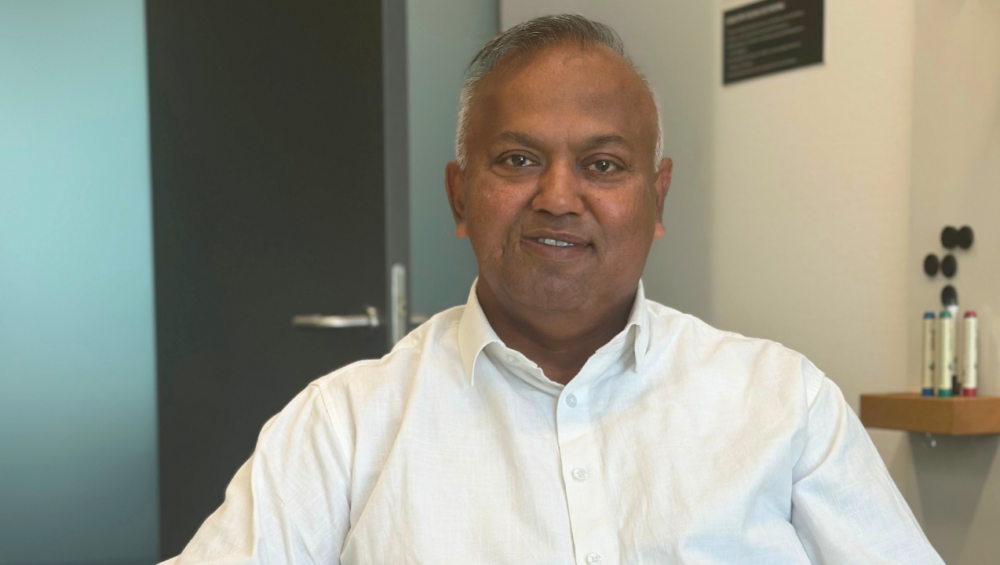
As the saying goes, still waters run deep, and Dr. Milan Kumar is a particularly striking example of this. He is someone who is deeply at home in the world of IT, data, AI, and robotics, yet speaks an unusual amount about people —about attitude, respect, curiosity, and the ability to continually embrace new things. It is precisely this combination that makes his journey so special and successful.
Boot Sequence: India, Europe, the U.S., Africa, Switzerland
Milan looks back on an international career that has taken him from India through Europe, the U.S., and Africa to Switzerland. His career began at the turn of the millennium in IT and management—at a time when technology was synonymous with new beginnings. He realized early on that true transformation does not take place in systems, but in people, and that technological excellence and skills alone are not enough for success.
As a CIO, program manager, and later as a board member of international companies, Milan was responsible for global IT and digitalization initiatives for organizations with tens of thousands of employees over many years. He established production sites, integrated complex system landscapes, and spearheaded digital transformations across national and cultural boundaries. What sounds technically challenging—and undoubtedly was—was often even more challenging on a human level.
The actual source of the error is not in the code
What runs through all these stages is his deep conviction that technological change is hardly a technical issue.
"90–95 % of all digital transformations fail not because of technology, but because of people."
For Milan, technology is a tool. What matters most is how people deal with change—how well they are engaged, supported, and taken seriously. That’s why he prefers to talk about change management rather than tools, curiosity rather than efficiency, and adaptability rather than rigid career paths.
Intentionally in perpetual beta, with bugs treated as features
He sees staying curious and being able to adapt as one of the most important skills of all—today more than ever. This mindset has been a constant throughout his life: new countries, new cultures, new roles, new responsibilities. For him, change was never a threat, but rather an opportunity to learn. Not everything always worked out or was a success, but it always contributed to his personal growth.
His international experience has had a profound impact on him. Living and working in different cultures has shown him how important it is to listen, respect local values, and not use himself as the standard. For Milan, successful collaboration always begins with respect and a willingness to question his own perspective.
A legacy that no one can erase
Today, Milan lives and works in Switzerland. After many years at large corporations, he made a conscious decision to embark on a new chapter. As an interim CIO, consultant, and entrepreneur, he helps companies effectively integrate digital transformation, data, AI, and sustainability. He does this not as an end in itself, but with an eye toward long-term impact.
What drives him most in this endeavor is the desire to create a legacy. Milan wants to build something that will have an impact beyond himself: a platform that opens up opportunities, shares knowledge, and enables others to have experiences similar to the ones he himself has been fortunate enough to have. He especially wants to give young talents the space to learn, experiment, and grow. In this way, he hopes to give back some of what he has been fortunate enough to receive.
Knowledge Without a Paywall
Milan shares his knowledge not only through projects, but also as an author, lecturer, and speaker. He has written several books on topics such as data and AI, smart factories, Industry 4.0/5.0, and data monetization, and teaches at universities. His content is deliberately practical, drawn from real-world experience rather than theoretical abstraction. His TED Talk on the connection between digitalization and sustainability (“Digitainability”) also follows this approach: technology as an enabler of responsibility. Through this commitment, he aims to help bridge the gap between ideas and reality. Milan believes there are too many brilliant ideas that never become reality because they lack a connection to the real world.
And what about Zentroom?
For Milan, zentroom is a place that just feels right. Light, tranquility, openness, and people. He explains that he intuitively senses whether spaces give or take energy. At zentroom, he has found exactly that: a professional environment that remains human. A place where he can focus on his work without losing the sense of connection.
He values the community not for its size or its promise of networking, but for its quality: diverse people, unique paths, and encounters among equals. Milan feels connected to this place, which is as much a part of him as he is a part of it.
Maybe that’s why Milan fits in so well at zentroom. He shows that the future isn’t just about technology, but about people who remain curious, treat each other with respect, are adaptable, and are willing to share their knowledge.